
Morton County Probate Court
Probate in Morton County is handled by the District Court. The official Morton County District Court page says Kansas district courts have general original jurisdiction over probate and administration of estates, guardianships, conservatorships, care of the mentally ill, juvenile matters, small claims, divorce, civil cases, and criminal cases. That means probate records route through the court clerk and statewide district court record systems, not a separate county probate court.
The correct local office name is Probate Division of the District Court. Estate and guardianship users should not confuse the court clerk with the Morton County County Clerk or the Register of Deeds. The Clerk of the District Court handles court filings and case records. The Register of Deeds handles land records that may support estate research, such as deeds, mortgages, releases, easements, oil and gas leases, and plats.
The court structure comes from the Morton County District Court page and the Kansas district court system.
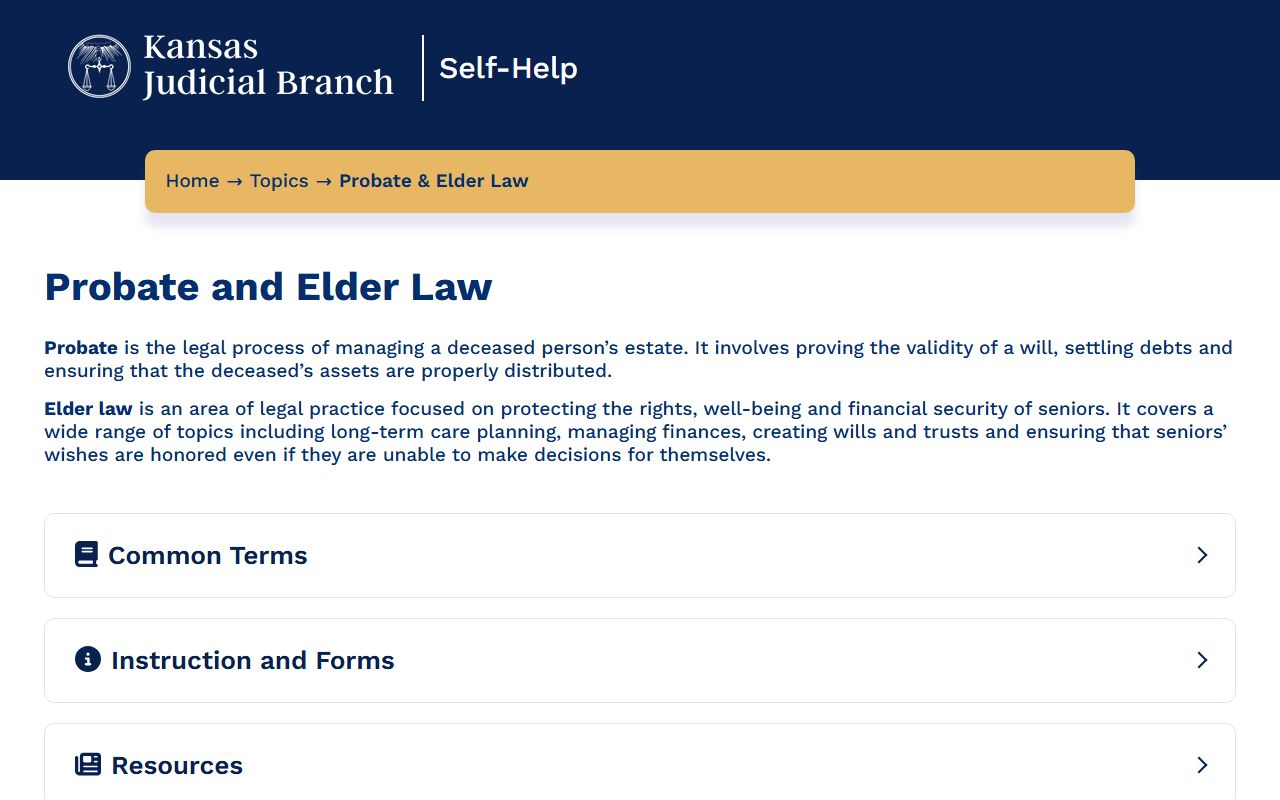
Kansas self-help probate information helps explain statewide probate concepts, but Morton County probate filings still go through the local district court.
Morton Probate Terms Defined
Probate files use terms that can be unclear if the record is being searched for family, title, or creditor reasons. The definitions below keep the terms tied to the common Morton County probate record categories found in the research.
- Testator
- A person who made a will.
- Executor
- A person named in a will to carry out estate duties after court appointment or approval.
- Intestate
- Dying without a will, which can require estate administration under Kansas law.
- Guardianship
- A court case involving authority to make personal-care decisions for a minor or adult.
- Conservatorship
- A court case involving management of another person's money or property.
- Letters
- Court-issued authority, such as letters testamentary or letters of administration, used to act for an estate.
Morton County Probate Records Include
Common Morton County probate record categories include wills filed for probate, estate administration petitions, letters testamentary, letters of administration, inventories, appraisements, creditor notices, demands, petitions for allowance of demand, final accountings, final settlements, guardianships, conservatorships, trust-related filings brought into court, and small estate affidavit material.
Those records can answer different questions. A will may identify beneficiaries. A petition may name heirs and interested persons. An inventory may describe estate assets. A demand or creditor notice may show claims against the estate. Guardianship and conservatorship records may show appointments and oversight orders, although some personal or medical details can be restricted.
- Estate files can include petitions, orders, letters, inventories, notices, claims, accountings, and final settlement papers.
- Will records become court records when filed, but access can depend on case status and confidential attachments.
- Guardianship files can include appointment, reporting, and oversight records for minors or adults.
- Conservatorship files focus on money, property, accounting, and authority to act for another person.
- Estate land records may require both the court file and Register of Deeds records.
Search Morton County Probate Records
Modern public probate cases may appear through Kansas CaseSearch if they are available for public district court access. If the probate case does not appear online, use the courthouse terminal or contact Morton County Clerk of the District Court. Kansas Judicial Branch guidance says public records are available at each courthouse and each court has a computer reserved for public court searches.
For copies or certified probate documents, make a written court-record request to the district court clerk. State guidance lists $0.25 per page for court copies and $10 per certified document. If the probate search involves real estate, use the Register of Deeds for the property side of the research because that office keeps permanent land records dating back to 1886.
- Search Kansas CaseSearch for a public district court probate case by name, case number, or available search criteria.
- If online results are missing or limited, use the courthouse terminal or call the Morton County Clerk of the District Court.
- Make a written request when a plain copy, certified copy, decree, letters, or filed probate order is needed.
- Use the Register of Deeds to trace estate property, deeds, mortgages, releases, easements, oil and gas leases, and plats.
- Confirm any restricted guardianship, conservatorship, care and treatment, or sealed material with the court clerk.
Morton Probate Contact Cards
Morton County has one probate court channel for local court filings: the District Court. Estate land research may also involve the Register of Deeds. These offices are distinct, and neither should be treated as a substitute for legal advice.
Probate Division of the District Court
1025 Morton Street
P.O. Box 825
Elkhart, KS 67950
620-697-2563
Monday-Friday, 8 a.m.-noon and 1 p.m.-5 p.m.
Morton County Register of Deeds
1025 Morton Street
P.O. Box 756
Elkhart, KS 67950
620-697-2561
Monday-Friday, 9 a.m.-5 p.m.; last day of month 9 a.m.-4 p.m.
Kansas Probate Forms
Official Kansas probate form sources are statewide. The Kansas Judicial Council probate forms page lists K.S.A. 59-2210 Probate Hearing Notice and Petition for Allowance of Demand as public probate forms. The broader Probate Forms 3d publication includes sample forms for judicial and nonjudicial procedures for decedent estates, care and treatment, guardianships, and conservatorships.
The publication is intended for probate attorneys and does not contain detailed procedural instructions. Research found pricing for print, CD-ROM, and online access for non-attorneys, while active Kansas attorneys registered under Rule 206 receive free online access. Kansas Self-Help Probate and Elder Law also notes probate forms and a Small Estate Affidavit for heirs.
The probate self-help source is available from Kansas Probate and Elder Law self-help.
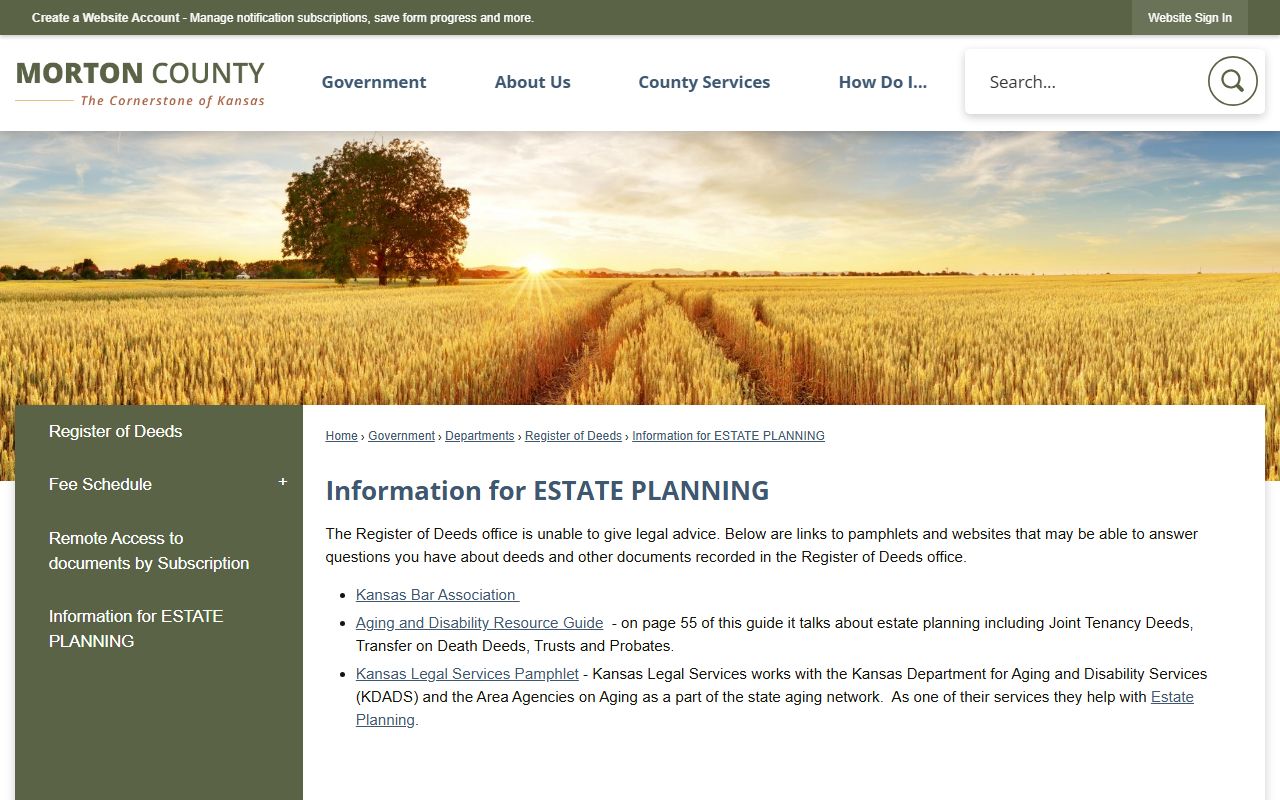
Morton County estate-planning materials direct users to legal resources and make clear that county offices cannot give legal advice.
Morton Probate Fee Schedule
The research did not locate a Morton County-specific probate filing fee schedule on official local pages. Court copy and certification fees come from Kansas Judicial Branch court-record guidance. Register of Deeds fees matter when a probate matter involves recording or researching estate property records.
| Item | Amount or Finding |
|---|---|
| Probate filing fee | No Morton County-specific probate filing fee found in reviewed official sources |
| Court copies | $0.25 per page under Kansas Judicial Branch court-record fee guidance |
| Certified court document | $10 per certified document |
| ROD first page recording | $21 |
| ROD additional page | $17 |
| ROD certifying instrument | $13 |
| ROD remote access day | $25 |
| ROD remote access month | $250 |
| ROD remote access 6 months | $600 plus $0.25 per page printed |
| ROD remote access 1 year | $800 plus $0.25 per page printed |
The Register of Deeds recording fees are shown on the Morton County Register of Deeds fee schedule.
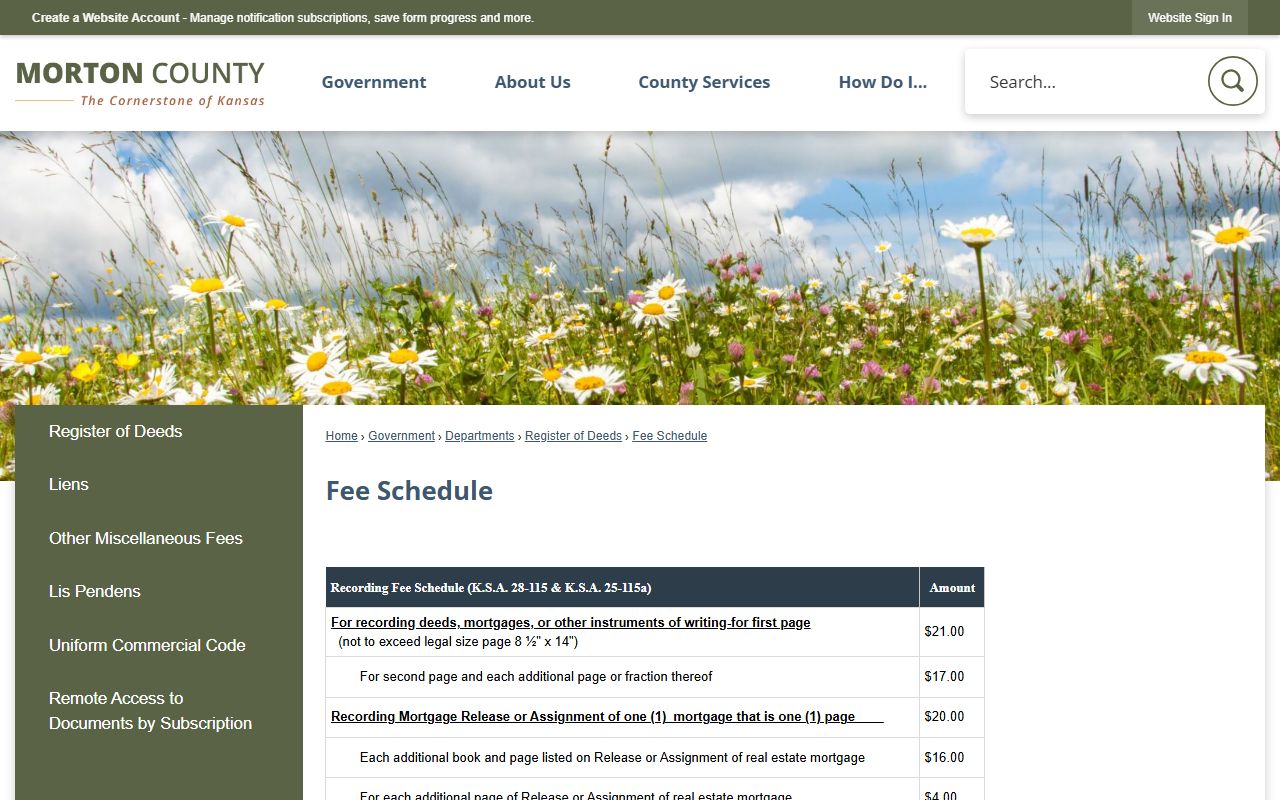
Those recording fees support estate property work, but they are separate from court filing fees and court copy fees.
Estate Land Records
Probate research often turns into property research. The Morton County Register of Deeds records, maintains, and preserves deeds, mortgages, mortgage releases, easements, oil and gas leases, and plats. The office states that its records date back to 1886 and are permanent. Most records it keeps are open to public inspection, except Kansas Real Estate Sales Validation Questionnaires and military discharges, which are closed by statute.
The Register of Deeds offers remote document access by subscription and short-term CIC access. Long-term accounts are handled by calling the office, while short-term access can be obtained through CIC. The office says it cannot perform searches, so users should be ready with names, legal descriptions, dates, or document references when researching estate property.
The land-record office information comes from the Morton County Register of Deeds page.
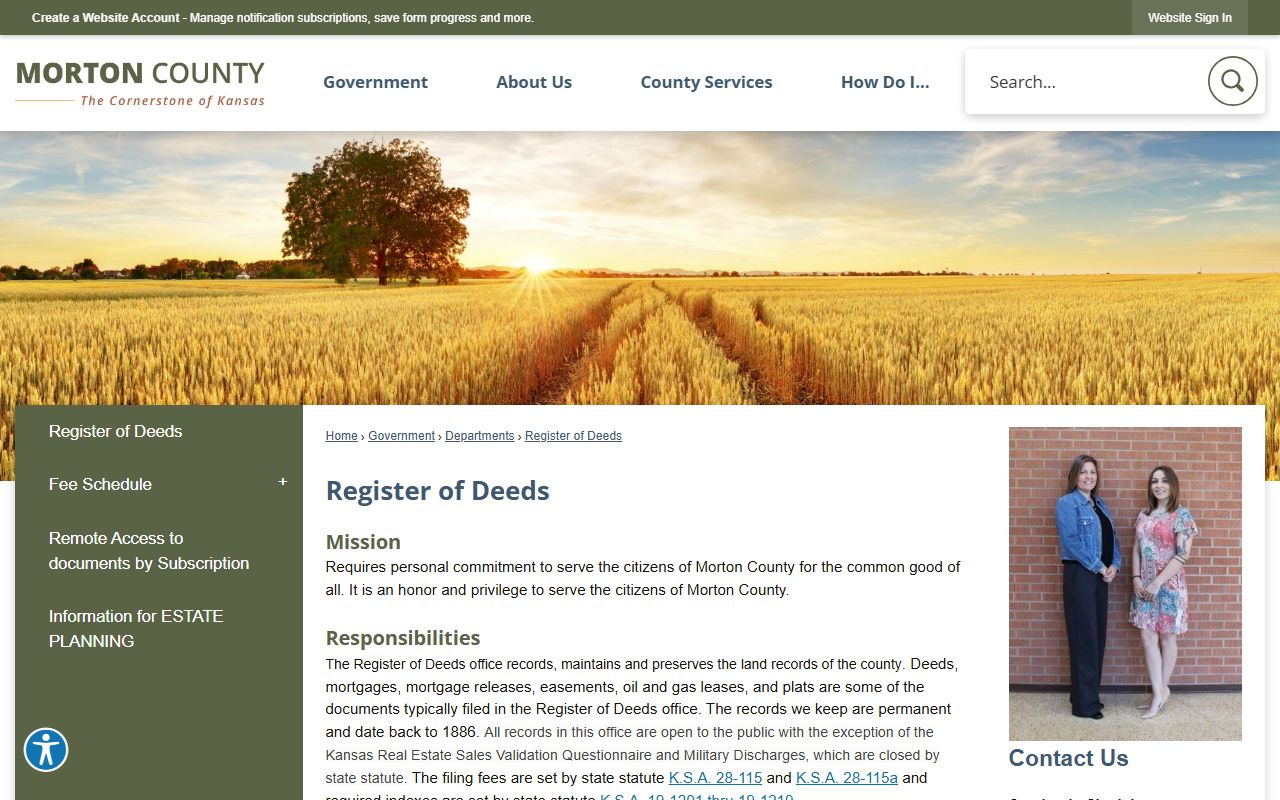
Use Register of Deeds records to trace estate land, but use the Probate Division of the District Court for probate petitions, orders, letters, and estate case files.
Morton Probate Remote Access
The Register of Deeds remote access program is helpful for estate land research, not for full court probate case searches. It provides access to recorded documents indexed back to 1886 through a subscription or short-term access route. That can help when an estate file mentions real property, a deed must be traced, or a recorded court order needs to be located in land records.
The remote document access source is the Morton County remote access subscription page.
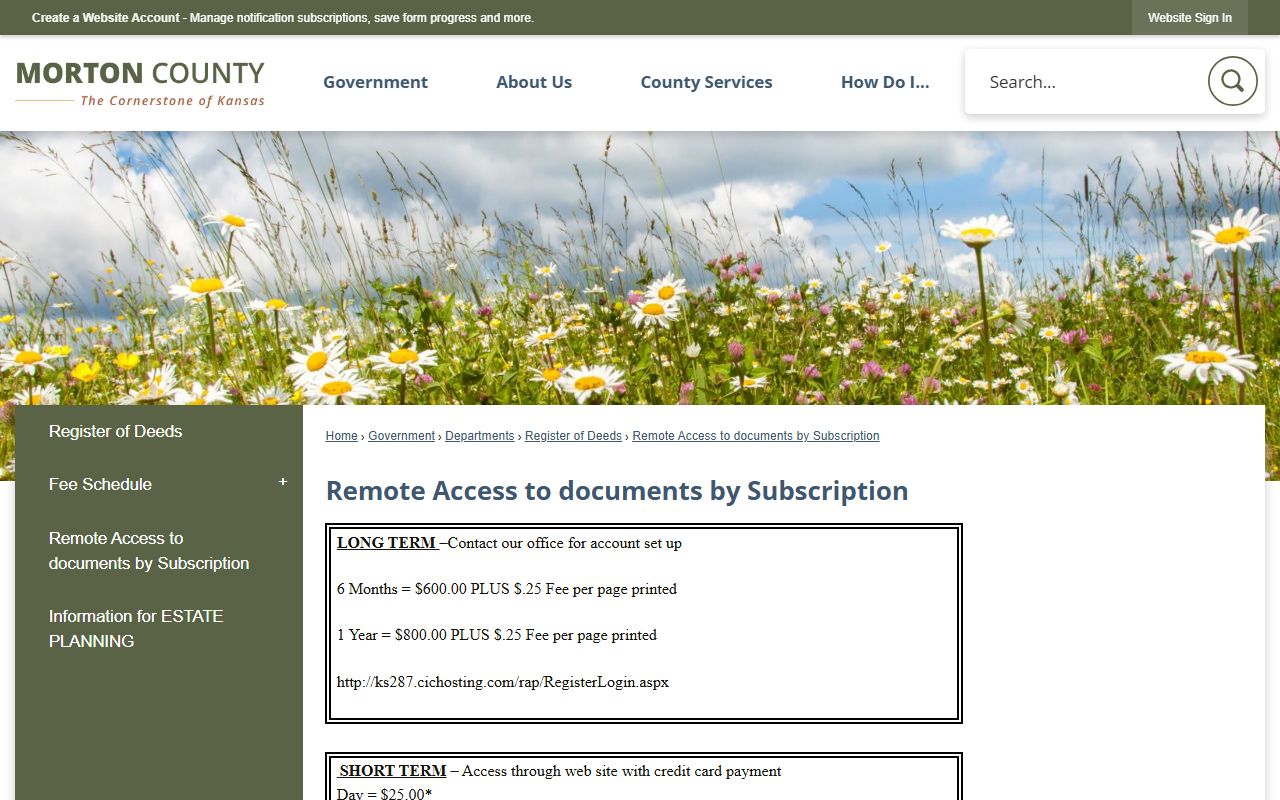
Remote land access can reduce travel for property research, but probate case copies and certified court documents still route through court-record request channels.
Restricted Morton Probate Records
Not every Morton County probate record is fully public online. Guardianship and conservatorship files may contain sensitive personal, medical, financial, or protected-address details. Care and treatment records are not ordinary public files. Confidential attachments, sealed orders, and personal identifiers may be redacted or withheld even when a docket entry or basic case information is public.
The court clerk can provide access procedure, copy, and certification information, but cannot provide legal advice. The Register of Deeds also points estate-planning users to legal resources and says the office cannot provide legal advice. If a probate issue affects title, creditor rights, guardianship authority, or distribution, legal advice may be needed before relying on a record search alone.
Note: Research found no Morton County probate docket, will-safekeeping policy, small-estate threshold summary, local bond rule, or probate checklist in official county sources.